
To be Divine: is it a blessing? Or a curse? A semi-spoilery review of Rachel Gillig’s first book in “The Stonewater Kingdom” series
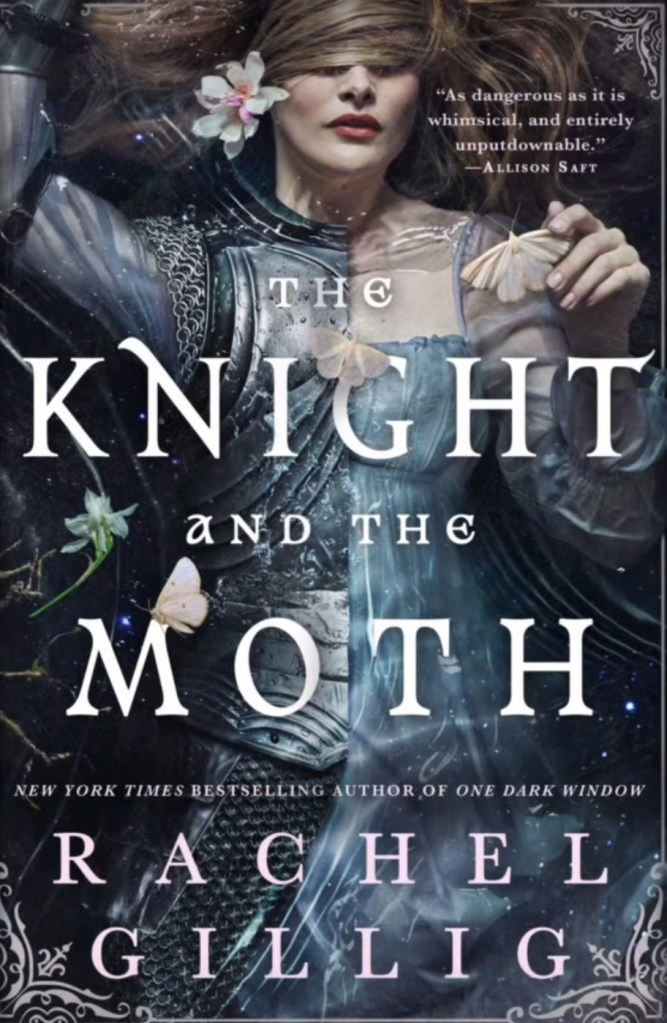
Hello and happy Wednesday everyone! Today I’m going to be talking about a book I was very excited to read: Rachel Gillig’s “The Knight and the Moth,” the first in “The Stonewater Kingdom” series. The second one is already slated to be released this September, so yay for not having to wait so long! For now, let’s dive in.
But first, a synopsis: This story follows Six, one of the six Diviners of Aisling Cathedral. These six women hold the power to dream; to be drowned in the sacred springwater of the cathedral and interpret visions they receive from the six Omens on behalf of those who ask for them. Glorified fortune tellers, if you will. The six Diviners know no life before the cathedral, and they are to serve for ten years before they can move on.
When the time comes for the women to finally be released from their sacred duties, the Diviners start disappearing one by one, until only Six is left alone. Desperate, she joins forces with a knight who believes all she stands for is foolish and a load of hogwash. As she begins her journey outside the cathedral’s walls and sees the world for what it really is, suddenly the beliefs she has clung to so desperately are hanging on by a gossamer thread. Will she be able to find her fellow foundlings? Or will the truth of her entire existence cause her to crumble?
My star rating: 3 out of 5 Divine stars.
Okay, so this is an odd one for me. Normally I wouldn’t want to continue with a book series when I’ve rated it three stars or lower, but I am… intrigued by this story. There are many little reasons that caused me to rate it this way, so let’s dive in.
First, the beginning felt very slow for me. The pacing, the flow… it just never hooked me in. There would be nights when I was reading where I would force myself to keep going. Normally this is a huge sign to just, you know, stop reading the book, but I wanted to like it. I’ve heard so many good things about Gillig’s “The Shepherd King” series (one that’s still on my TBR list), so I wanted to keep going and give this book the benefit of the doubt. I pushed, and I pushed, and finally I felt it click. I was just sad that it took so long for it to do so for me. Could be me, since the book has a 4.25 rating on Goodreads.
There were moments in the beginning that felt almost out of place and pulled me out for a minute. There is a scene where the Diviners go out with some knights and attend a festival or faire of sorts, and get drunk and high on the world’s version of marijuana. These are supposed to be sacred women. They serve the Omens, who are supposed to be gods. They drown every day for it. It felt like the book couldn’t decide if these were women or other-worldly beings. Physically and literally they are women, but do we see nuns or monks going out and getting drunk and high? Just felt a bit odd to me.
In fact, it all felt very informal. The knights serve a king, Benedict Castor. While I get that people can be chummy with kings and such, some of the knights closest to him call him Benji. “Benji”? It felt odd for a king – even a boy king – to be addressed in such a way. It blurred the lines very well, which I guess is how the twist at the end was able to come to fruition.
I did really like Six and the main knight, Roderick (Rory). They had a cute banter that I always enjoy. Rory is one of the knights that does not believe in the Omens or their power. He is deemed a heretic, and Six has no patience for heretics. However, she is able to see that, heretic or not, he is quite handsome. I think that irks her and amuses Rory, which is always amusing.
Six herself is an interesting character. She is so named because the six women who begin their service at the cathedral are to forget their lives before their time there. They are all foundlings, all Diviners, and their purpose is to dream and read the visions of the Omens. Names bring them down; humanize them. However, Six remembers her name: Sybil Delling. No one knows it but herself. There is power to a name. We’ve seen it in many books. Six, while performing her duties admirably, only wishes to finish her time at the cathedral and move on with her life. Maybe find a nice place to settle down, get married, have a family. The usual dream that tends to come up a lot. But when her fellow Diviners start disappearing and she ends up being alone, she sacrifices everything to find them. She is a fierce and loyal friend; she never strays from her mission of finding them and I found that to be quite admirable. A huge gold star in my book. I’d want Six on my side.
The book finally starts to pick up for me when we find out what Rory and Co. are up to. I don’t wish to spoil too much of the story, but in basic terms, they are on a sort of scavenger hunt to try and find certain items for the king. Because Six needs help with her own quest to find the other Diviners, she goes along with them and is now a part of their quest. She eventually evolves from a woman who is merely meant to dream to a woman who is meant to fight for what she believes in – truly believes in. It’s great character growth to me. She believed in what others told her to believe in until she was able (and willing) to believe in what she decided for herself. Probably my favorite character.
My second favorite character: the gargoyle! This little stony dude managed to grow on me. There are many anthropomorphic gargoyles that serve as sort of protectors of the cathedral. They are loyal to the Aisling Cathedral and to whoever resides in it. One of the gargoyles, affectionately called “gargoyle”, finds out about Six leaving and wants to tag along. She eventually gives in, mostly because he simply followed her without her knowing for a bit, and the two of them join up with the king and his knights on their journey. He is obnoxious, he is whiny, he is lazy, he is ridiculous… and I love him all the same. The way his character is written, his horrible qualities are almost charming. It’s amazing. He is also very strong and very loyal to Six. I’m a sucker for a well-written, loyal friend. Plus, there is more to him than meets the eye, and when that comes to light, he becomes a more fleshed-out character with more depth and heartbreak.
Some of the things that irked me as a reader: repeated words. Every time I saw the word “ignoble” or “gossamer” I would flinch. It’s too much; we know Six thinks Rory is “ignoble.” We know the clothing and shrouds the Diviners wear are made of gossamer thread. We get it. To be used so much takes away from the words themselves and begins to grate. I’d have alcohol poisoning if I made it into a drinking game. Plus, Six’s shroud should’ve become sentient and become it’s own character for how much it was mentioned and involved in the story.
Another thing that’s actually a bit of a bigger issue for me is the world-building throughout. The Stonewater Kingdom is mentioned, the Aisling Cathedral is mentioned, and the five hamlets surrounding the area are mentioned – even visited. But the world outside the cathedral is thinner than I’d like. We barely know the people. We barely know the area. The hamlets seem to be connected to a distinct Omen/god. That’s cool, but do they work together? Each hamlet felt very separated from each other and had their own distinct themes; but to make a kingdom work means working together as a whole. Import/export, jobs, agriculture, etc. It felt disjointed, and I’m not sure if that’ll come up in the second book or not. It just seemed like the hamlets were there just to be a stepping stone for the protagonists’ quest, not because hamlets/villages are needed to make a kingdom work and thrive.
So, the beginning drags, the middle/almost-the-end hits really well and keeps me immersed, and the end? The end hits like a punch in the face.
The ending has a “twist,” but if you pick up on some context clues you can tell what’s going on beforehand. It’s the whole, “This character’s acting sketchy” kind of vibe, or “This character’s doing out-of-character things.” So it wasn’t the biggest shock to me, what happened. I think it was more of the pacing and the reason behind why they did what they did.
The twist was jarring. No joke, this book is 385 pages and all the shit hits the fan and the twist comes out on page 379. Just overall very sudden and it doesn’t give you a chance to breathe after the final climactic event. While I understand that this can happen, especially in a book that is known to have a sequel (a cliffhanger, if you will), it just felt shoehorned in. Almost a cheesy way to get people to read the next one. But with Rachel Gillig’s reputation, I felt like people would’ve already been planning on reading the sequel, so why the sharp and quick ending?
And the reasoning behind it? Again, the book gave us 6 pages to take it all in, so there wasn’t a whole lot of time to give us all the context of a motive, but what we got just felt… cheap. Like, “That’s really why you’re doing this?” Almost cartoonish. I was almost waiting for the person to start twirling their mustache and let out a Snidely Whiplash laugh. “NyahaHA!” I’m hoping there will be more to their motive in the next book, because it feels too thin.
With all that being said, I’ll read the next book in the series. I’m not sure if there will be more than two books in this. It may be a duology just like her previous series. I think the second half of the book hooked me enough to keep going. I just wish it didn’t take so long to get going.
Have you read “The Knight and the Moth”? What did you think? Are you a fan of huge and sudden cliffhangers? Let me know down in the comments below, I love to hear from you!
Until next time, my lovelies!

 monicareadsthrough.com