

A spoiler-free review of the fantasy horror novella, a follow up to “What Moves the Dead” by bestselling author T. Kingfisher
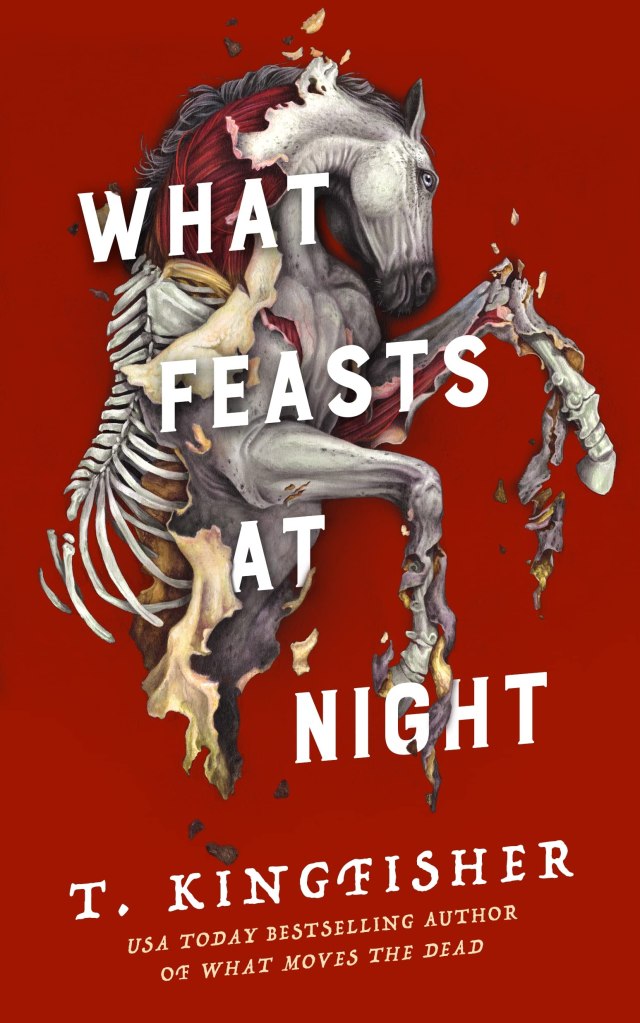
Hello and happy Wednesday! Hope everyone’s having a good week so far. Today I’m bringing you a review for T. Kingfisher’s latest book, “What Feasts at Night,” the next book in the “Sworn Soldier” series and a direct follow up to the novella, “What Moves the Dead.” I was excited to finally get this book as I’ve been waiting for it since I finished “What Moves the Dead” last year. I gave that novella 3.5 stars and rounded it up to 4, but I do remember enjoying it and being excited that there was a sequel coming. Probably because of my love of the main character, Alex Easton.
Here’s a quick synopsis: Alex Easton, after surviving a gruesome war and the horrible events at the Usher house, is ready to take a break. Instead of some much-needed R&R, they find themselves traveling home to cold and dreary Gallacia with their companion, Angus. Soon they find that things aren’t quite right: the caretaker Easton hired to watch over their family’s lodge has died, the townspeople are uneasy, and there’s definitely something in the air, which presses uncomfortably on Easton’s eardrums every time they step outside. Plus there are tales being told about the evil spirit that enters dreams and steals the breath straight from a person’s lungs…
My rating: 4 out of 5 stars.
I don’t know, y’all. I think I’m digging novellas more and more. Bite-size morsels of intrigue, mystery, and heart. This story started off slow, but that’s what I liked about it. It was a slow trickle to the horrors Easton’s family lodge was facing. While this book is labeled as “horror,” it doesn’t always have to be full of blood and gore. T. Kingfisher does a great job of setting the scene and making the environment feel eerie and unsettling. I could almost feel the thick air and silence stretching across the landscape. While it can feel soothing when needed, too much silence can make a person feel jittery and paranoid. Adding the story about the moroi (the woman that enters your dreams, sits on your chest, and steals the breath from your lungs) sure doesn’t help.
As always, I love Alex Easton. Even though they’ve been through a brutal war as well as the events of the Usher House in the last novella, they still manage to keep their dry wit and humor about them. There are some lines that made me smile wryly, but they also had lines that made me purse my lips and go, “hmm” with contemplation. They are a logical person; even after the crazy events at the Usher House they still don’t readily believe in ghost stories and superstitions, which the story of the moroi is. This is made prevalent in this line:
“What happened in [the Usher House] on the edge of the tarn was unspeakably awful, but there was nothing supernatural about it. Nature creates horrors enough all by itself.”
I just love that line because of how true it really is. Who here has seen a photo or read an article about some beast or plant that is terrifying and should be “out of this world” but in fact has been here for millennia before us and will most likely be here for millennia after? *raises hand*
Yeah… nature’s messed up, man.
With that being said – about Easton being a logical person – it is an interesting turn of character near the end that shows the reader that maybe after all this, they can’t truly think logically about strange goings-on anymore. Not after the events of this book.
As is true in any novella, the cast of characters isn’t vast. There’s Easton and their companion Angus. There’s Miss Potter, a mycologist visiting for several days to study the local mushrooms. I was worried for a hot second about this; I really didn’t want another mushroom-related horror story, especially in the same series! Thankfully, there were no evil mushrooms, just Easton having a jolt whenever Miss Potter mentioned them. Rounding off the cast are Mrs. Botezatu, the Widow, and her grandson, Bors. They have been recently hired by Easton to take care of the property since the original caretaker died mysteriously.
The Widow is a superstitious old woman, and I liked seeing the juxtaposition of her and Easton. The whole “man of science, man of faith” thing. (Sorry, I just recently watched Lost.) The Widow believes in the moroi and does everything she can to ward her off, and Easton thinks it’s boohockey. It all comes to a head in the climax, though.
Bors, for the most part, is merely there for his grandmother and helps out with “burly man” things like chopping wood and tending to the horses. He gives off “Lenny” vibes and doesn’t speak much. He is a catalyst for when the horrors ramp up, but I liked him most in the very end of the book. When it’s all over and the reader is about to close the back cover, Bors asks to stay at the lodge and help with its upkeep. When asked why, he drops this banger:
“[The lodge] doesn’t deserve to fall apart because something bad happened here.” Another of his long silences, and then he added, “Something bad happened to both of us, too. We don’t deserve to fall apart either.”
Chef’s kiss, Bors. Well said, buddy. A scary lesson to start and a tough lesson to continue, but an important lesson in the end.
The horror aspect is definitely very environmental and subtle; there’s no blood and guts flying about. The tale about the woman sitting on your chest and stealing your breath is a well-known one, and T. Kingfisher does a great job with the description of the woman and how eerie she is. There are graphic depictions of flesh and bone being decrepit and decaying, so if you’re squeamish about that, read with care and caution.
Have you read “What Feasts at Night” or its predecessor, “What Moves the Dead” yet? How about other T. Kingfisher books? Let me know in the comments down below!
As always, until next time my lovelies!


LOVED What Moves the Night. Can’t wait to read this one too.
LikeLike
lol just realized I put “What Moves the Night” instead of “What Moves the Dead.” Think I was combining names
LikeLiked by 1 person